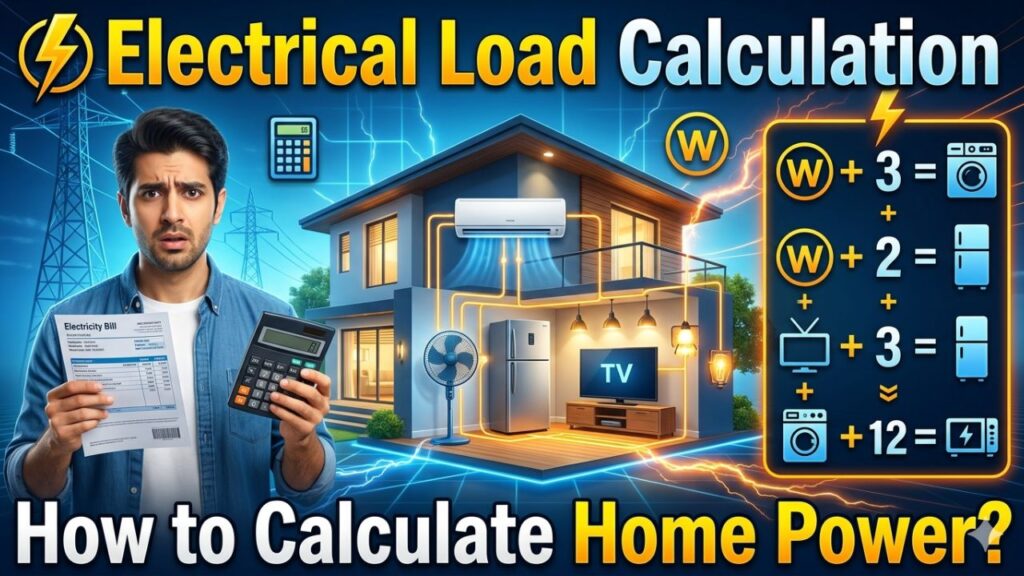
Electrical load calculation is an important step when designing or upgrading the electrical system of a house. It helps you understand how much electricity your home appliances consume and whether your wiring, main switch, and meter can safely handle that load. Without proper load calculation, there is a higher risk of circuit overload, frequent tripping of breakers, or even electrical fire hazards.
Many homeowners ignore electrical load calculation while building or renovating a house. However, knowing the total electrical load of your home helps in choosing the correct wire size, circuit breakers, and electrical panel capacity. It also helps when installing systems like solar panels, inverters, or backup generators.
In this guide, you will learn how to calculate electrical load for a home in a simple step-by-step way.
Quick Information Table
| Factor | Details |
| Purpose | To calculate total electricity usage in a home |
| Measured In | Watts (W) or Kilowatts (kW) |
| Based On | Power rating of appliances |
| Important For | Wiring, MCB selection, solar system sizing |
| Average Home Load | 2kW – 7kW |
| Safety Margin | Add 20–25% extra capacity |
What is Electrical Load?
Electrical load refers to the total amount of electricity used by all appliances and devices in your home. Every electrical appliance consumes a certain amount of power, which is usually mentioned in watts (W) on the device label.
For example, a fan may consume around 75 watts, while an air conditioner may consume 1500 watts or more. When multiple appliances run at the same time, their combined power consumption becomes the total electrical load of the house.
Knowing the total load helps electricians design a safe electrical system that can handle the required power without overheating or overloading.
Step 1: List All Electrical Appliances in Your Home
The first step in load calculation is to list all electrical appliances used in your home. Each appliance has a power rating written on its label or manual.
Common household appliances include lights, fans, refrigerators, televisions, air conditioners, washing machines, and kitchen appliances. Write down the power rating of each appliance and also note how many units of each device are used.
Common Household Appliance Power Ratings
| Appliance | Average Power |
| LED Bulb | 9–12 W |
| Ceiling Fan | 70–80 W |
| LED TV | 80–150 W |
| Refrigerator | 150–300 W |
| Laptop | 60–90 W |
| Washing Machine | 500–700 W |
| Microwave Oven | 800–1200 W |
| Air Conditioner | 1500–2000 W |
These values are average estimates. The actual power rating may vary depending on the brand and model.
Step 2: Multiply Power by Quantity
After listing appliances, the next step is to calculate the total power consumption of each category. This can be done by multiplying the power rating of the appliance by the number of units used.
For example, if your house has four ceiling fans and each fan consumes 75 watts, the total load from fans will be:
75 W × 4 = 300 W
Similarly, if you have six LED bulbs of 10 watts each, the load will be:
10 W × 6 = 60 W
By repeating this calculation for all appliances, you can find the total load contributed by each device type.
Step 3: Calculate Total Electrical Load
Once you have calculated the load for each appliance category, add all values together. The result will be the total electrical load of your house.
For example:
| Appliance | Quantity | Power | Total Load |
| LED Bulb | 8 | 10 W | 80 W |
| Ceiling Fan | 4 | 75 W | 300 W |
| TV | 1 | 120 W | 120 W |
| Refrigerator | 1 | 250 W | 250 W |
| Washing Machine | 1 | 600 W | 600 W |
| Air Conditioner | 1 | 1800 W | 1800 W |
Total Load = 3150 W
This means the total electrical load of the house is about 3.15 kW.
Step 4: Add a Safety Margin
Electrical systems should never be designed exactly at the calculated load. It is recommended to add about 20–25% extra capacity to ensure safety and future expansion.
For example:
Total Load = 3.15 kW
Safety Margin (25%) ≈ 0.78 kW
Final Recommended Capacity ≈ 4 kW
This means the electrical wiring, main switch, and distribution board should be designed to handle at least 4kW load.
Step 5: Determine Required Main Circuit Capacity
After calculating the load in watts, you can estimate the current required for your home.
The basic formula used is:
Current (Amps) = Power (Watts) ÷ Voltage
In India, the standard household voltage is around 230V.
Example:
4000 W ÷ 230 V ≈ 17.4 Amps
So a 20 Amp main circuit would be suitable for this load.
Average Electrical Load of Different House Sizes
| House Type | Typical Electrical Load |
| 1 BHK | 2–3 kW |
| 2 BHK | 3–5 kW |
| 3 BHK | 5–7 kW |
| Large House | 7–10 kW |
These values can vary depending on the number of appliances used.
Why Electrical Load Calculation is Important
Electrical load calculation is important for several reasons. First, it helps prevent overloading of wires and circuits. When electrical load exceeds the capacity of wiring or breakers, it can cause overheating and potential fire hazards.
Second, proper load calculation ensures the correct selection of circuit breakers, distribution boards, and wiring sizes. This improves the safety and reliability of the electrical system.
Third, load calculation is also necessary when installing solar power systems, backup generators, or inverters. These systems must be sized according to the electrical load of the house.
Tips to Manage Electrical Load Efficiently
Homeowners can also reduce electrical load by using energy-efficient appliances. LED lighting, inverter air conditioners, and energy-efficient refrigerators consume much less electricity compared to older models.
Another useful practice is to avoid running multiple high-power appliances at the same time. For example, running an air conditioner, microwave, and washing machine simultaneously can increase peak electrical load significantly.
Regular maintenance of electrical wiring and appliances also helps maintain safe and efficient energy usage.
Conclusion
Electrical load calculation is a simple but very important step for every home. By calculating the total power consumption of household appliances, homeowners can design a safe electrical system that handles electricity demand efficiently.
The process involves listing all appliances, calculating their power consumption, adding the total load, and including a safety margin. This ensures that wiring, circuit breakers, and electrical panels are properly sized.
Whether you are building a new house, upgrading electrical wiring, or installing solar panels, proper electrical load calculation helps create a safe, efficient, and reliable power system for your home.
PMSG CALCULATOR – CLICK HERE