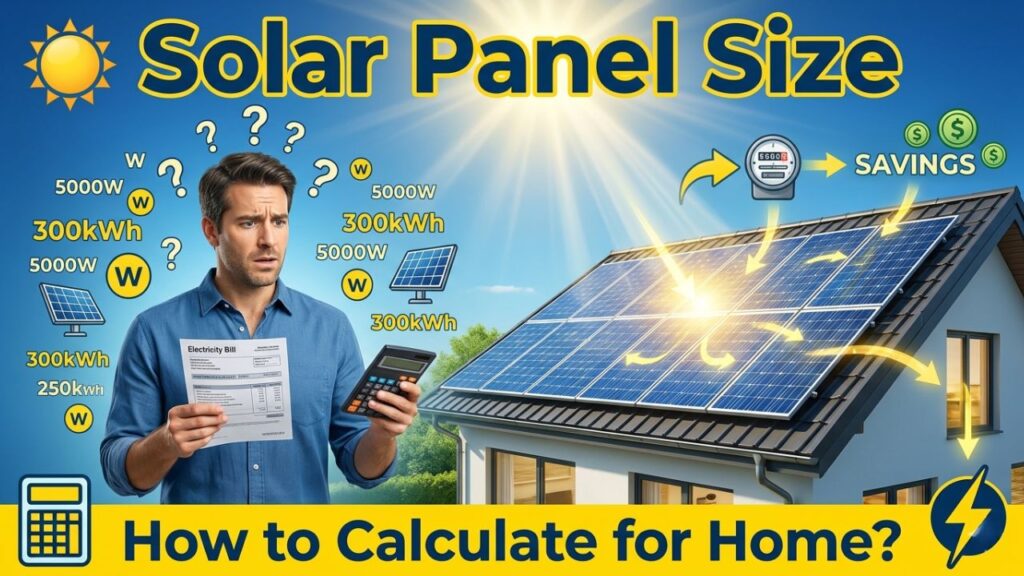
Solar Panel Size: Installing solar panels at home is becoming very popular. Many homeowners want to reduce their electricity bills and also use clean energy. However, before installing a solar system, it is very important to calculate the correct solar panel size for your house. If the system size is too small, it will not produce enough electricity. On the other hand, if the system is too large, the installation cost may increase unnecessarily. That is why understanding how to calculate the correct solar panel size for your home is very important before installing a rooftop solar system.
Information Table
| Factor | Details |
| Main Purpose | To calculate the correct solar system size |
| Based On | Monthly electricity consumption |
| Average Home System | 1kW – 5kW |
| Panels Needed | Depends on panel wattage |
| Average Solar Panel | 400W – 550W |
| Roof Space Required | Around 100 sq ft per kW |
Step 1: Check Your Monthly Electricity Consumption
To calculate the correct solar panel size, the first thing you need to know is your monthly electricity consumption. You can easily find this information on your electricity bill. Every electricity bill shows the total number of units (kWh) used in a month. This number helps you understand how much electricity your home consumes.
For example, if your home uses around 300 units of electricity per month, you will need a solar system that can generate approximately the same amount of electricity. In India, a 1kW solar system usually produces about 120 to 150 units of electricity per month depending on sunlight conditions. So if your monthly usage is around 300 units, a 3kW solar system would generally be suitable for your home.
Solar System Size Based on Monthly Electricity Usage
| Monthly Electricity Use | Recommended Solar System |
| 100–150 units | 1 kW |
| 200–300 units | 2–3 kW |
| 350–450 units | 3–4 kW |
| 500–600 units | 5 kW |
Step 2: Understand Solar Panel Wattage
Another important factor in calculating solar panel size is the wattage of the solar panels you plan to install. Solar panels come in different power ratings such as 400W, 450W, 500W, and 550W. Nowadays many solar installers prefer high-efficiency panels like 540W or 550W because they generate more electricity and require fewer panels.
Higher wattage panels are especially helpful when roof space is limited. For example, if you use 550W panels, you will need fewer panels compared to 400W panels for the same solar system size.
Common Solar Panel Power Ratings
| Panel Power | Panels Needed for 1kW |
| 400W | 3 panels |
| 450W | 3 panels |
| 550W | 2 panels |
Step 3: Calculate the Number of Solar Panels
Once you know your electricity consumption and panel wattage, the next step is to calculate how many solar panels you will need. This can be done using a simple formula.
Formula:
System Size (in watts) ÷ Panel Wattage = Number of Panels
For example, if you want to install a 3kW solar system and you are using 550W panels, the calculation will be:
3000 ÷ 550 ≈ 5.45
Since you cannot install a fraction of a panel, you will need about 6 solar panels.
Solar Panels Needed for Different System Sizes
| Solar System Size | Panels Needed (550W) |
| 1 kW | 2 panels |
| 2 kW | 4 panels |
| 3 kW | 6 panels |
| 5 kW | 9–10 panels |
Step 4: Check the Available Roof Space
Roof space is another important factor when calculating solar panel size. Solar panels require enough open roof area to be installed properly. On average, a 1kW solar system requires about 80 to 100 square feet of shadow-free roof space.
For example, a 3kW solar system may need around 300 square feet of roof area. If your roof is smaller, you may need to use high-efficiency panels that generate more power in a smaller area.
Your roof should also receive direct sunlight for most of the day and should not be blocked by trees, buildings, or shadows.
Roof Space Required for Solar Installation
| Solar System | Approximate Roof Space |
| 1 kW | 100 sq ft |
| 2 kW | 200 sq ft |
| 3 kW | 300 sq ft |
| 5 kW | 500 sq ft |
Step 5: Understand Daily Solar Power Generation
Solar panels generate electricity based on the number of sunlight hours available. In most parts of India, solar systems receive around 4 to 5 hours of peak sunlight per day.
Because of this, a 1kW solar system typically generates about 4 to 5 units of electricity daily. This means it can produce around 120 to 150 units in a month. A larger system such as 3kW can generate around 360 to 450 units per month depending on weather conditions and installation quality.
Average Solar Power Generation
| Solar System | Daily Power | Monthly Power |
| 1 kW | 4–5 units | 120–150 units |
| 2 kW | 8–10 units | 240–300 units |
| 3 kW | 12–15 units | 360–450 units |
| 5 kW | 20–25 units | 600–750 units |
Step 6: Consider Future Electricity Needs
While calculating solar panel size, it is also important to think about your future electricity needs. Many homeowners install solar systems only according to their current electricity usage. However, electricity demand often increases over time.
For example, you may buy an air conditioner, electric vehicle, or new home appliances in the future. These appliances will increase electricity consumption. Therefore, installing a slightly larger solar system can be a smart long-term decision if your roof space allows it.
Benefits of Choosing the Correct Solar System Size
Installing the correct solar panel size offers several benefits. First, it helps reduce your electricity bills significantly. In many cases, solar energy can reduce electricity bills by up to 70–90 percent. Second, solar panels have a long lifespan of around 25 years, which means you can enjoy clean electricity for decades.
Another advantage is that many governments offer subsidies or incentives for rooftop solar systems. These subsidies can reduce the installation cost and make solar energy more affordable for homeowners.
Conclusion
Calculating the correct solar panel size for your home is a very important step before installing a solar system. The calculation mainly depends on your monthly electricity usage, solar panel wattage, and available roof space. By understanding these factors and doing a simple calculation, you can determine the most suitable solar system for your home.
A properly sized solar system can generate enough electricity for your daily needs, reduce electricity bills, and provide clean energy for more than 25 years. For homeowners looking to invest in renewable energy, installing the right solar panel system is a smart and long-term decision.